Don't Rent Intelligence. Build a Learning System.
For a small teams, the durable AI advantage is the loop you build around the model. The model you pick matters far less than you think.
There are two worries that probably live in the same week of your life.
The first: your most experienced person, the salesperson or negotiator who can tell which objection is real and which is a distraction, the estimator who can eyeball a job and price it, the paralegal who knows how every judge in the county actually rules, the shop foreman who can hear a bad bearing, is a few years from retirement. Most of what makes them exceptional has never been written down. When they walk out the door, it walks with them.
The second: you’re paying for AI now. Maybe a few subscriptions, maybe a tool your team swears by. But if someone asked you what you’re actually getting for it, you’d struggle to answer with a straight face.
Those are the same problem. And solving them is the real opportunity in AI for a team your size, much more than picking the “right” chatbot.
The question everyone’s asking is the wrong one
For two years, the AI conversation has been stuck on which tool: which model, which vendor, which subscription. It feels like the important decision but it isn’t.
Models are becoming somewhat of a commodity. They get cheaper, more capable, and more interchangeable every few months. The one that’s best today won’t be best next year, and switching is getting easier, not harder. Betting your strategy on picking the winner is like betting your business on choosing the right brand of electricity.
Even the largest players are saying this out loud now. A few weeks ago Microsoft’s CEO Satya Nadella published an essay (titled “A frontier without an ecosystem is not stable”) arguing that chasing the best model is a losing game. The real advantage, he says, is whether a company can turn its own work into intelligence it owns and keeps improving. He calls that a learning loop. The durable asset is the system you build around the AI, the thing that gets smarter every time your people use it.
That sounds abstract but at reasonable scale, it’s actually very concrete.
What a “learning loop” really is
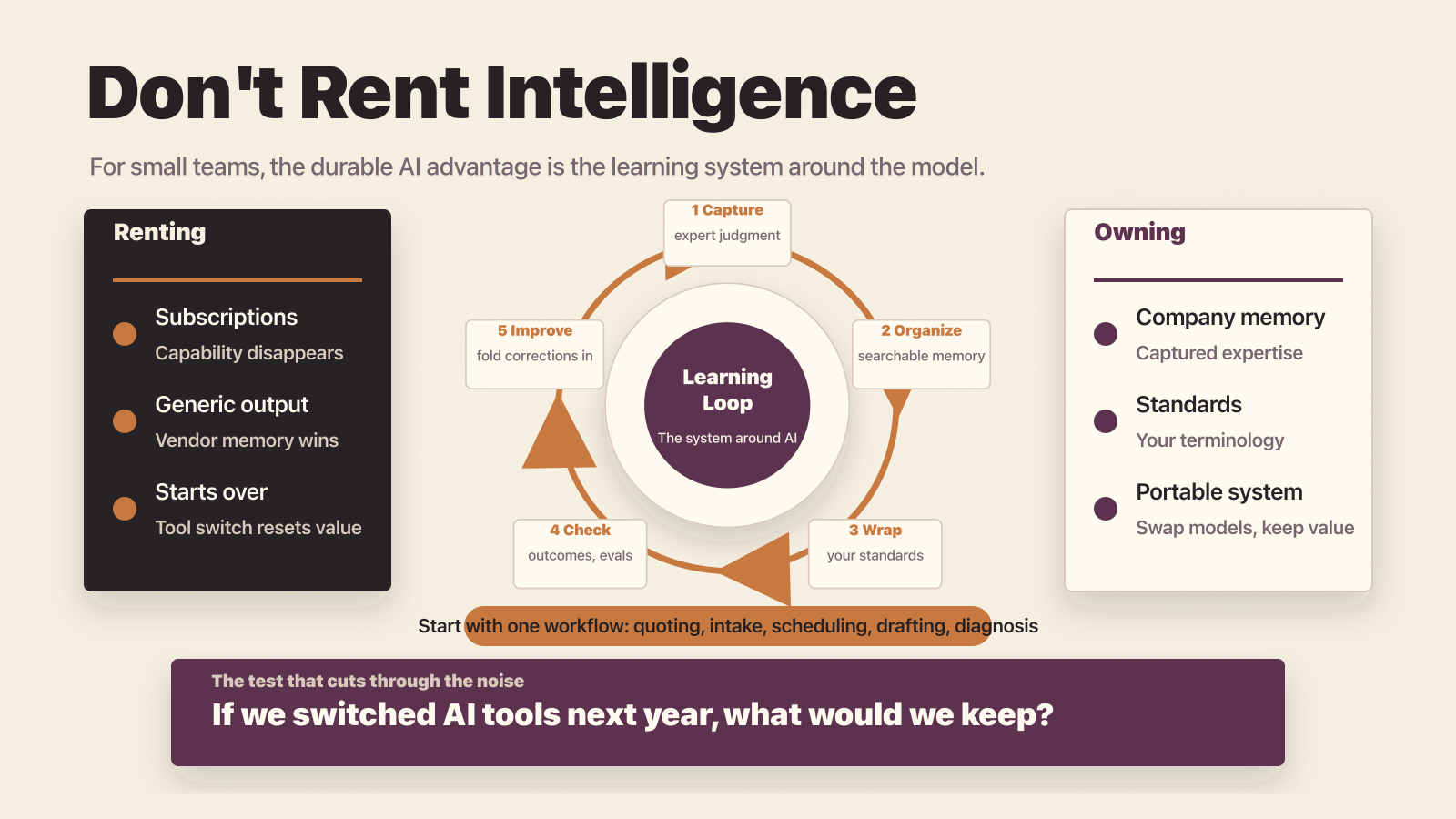
Strip away the jargon and a learning loop is a way of capturing how your best people work, so that AI can apply it consistently, and so the company keeps that knowledge even after the person, or the tool, is gone.
It has a few plain parts:
- Capture how the work actually gets done: the decisions, the judgment calls, the corrections your experts make without thinking about them.
- Organize it so it’s instantly searchable, a kind of company memory the AI can draw on.
- Wrap the AI in your standards (your processes, your terminology, your “this is how we do it here”) so it produces your work, not generic output.
- Check that it’s actually helping, not by vibes but against outcomes, metrics and evals you care about: faster quotes, fewer errors, shorter onboarding.
Do that, and every time your team uses AI, a little more of your company’s expertise gets captured and reused instead of evaporating. The system compounds. That’s the loop.
Notice what’s not on that list: building your own AI, training expensive custom models, hiring a data-science team. Those make headlines, and for a hospital system or a global consultancy they sometimes make sense. For nearly every small team, they’re a distraction. You can get the overwhelming majority of the value from the simple version above.
What this looks like in practice
Take a workflow most teams have: quoting a custom job. Today one person does it well because they carry twenty years of “this kind of job always runs over” in their head. Capturing that loop isn’t a big software project. It’s sitting with them while they quote a few jobs, writing down the questions they ask, the red flags they catch, the adjustments they make, and turning that into something a model can follow. After that, a newer estimator drafts a quote, the AI checks it against how your best person actually thinks, and every correction along the way gets folded back in. When your expert is out, the work doesn’t stop. When they retire, their judgment doesn’t leave with them.
That’s the process in miniature. Nothing exotic. The expertise stops living only in one head, and the team keeps it.
Small teams have the advantage here, they just don’t know it
This is the part that surprises people: the learning-loop idea gets stronger the smaller the team.
A 50,000-person enterprise takes years to change how it works. A small team can change how it works this quarter. Your expertise isn’t scattered across a hundred committees. It lives in a handful of people you talk to every day. Your “how we do it here” is real and specific and yours, not a watered-down industry average. The loop turns faster in a lean team than it ever could in a giant one.
The risk is real too. If you don’t capture your own knowledge, the AI tools your team uses will happily absorb generic expertise and hand it back to everyone, including your competitors. The thing that made you worth hiring gets commoditized right out from under you. The teams that come through this era ahead won’t be the ones with the fanciest AI. They’ll be the ones that turned their own hard-won judgment into something durable while everyone else was comparing chatbots.
The one test that cuts through the noise
Ask this about any AI tool, vendor, or plan:
If we switched AI tools next year, what would we keep?
If the answer is “nothing, we’d start over,” you’re renting. You’re paying every month for capability you don’t own, and the day you stop paying, it’s gone.
If the answer is “we’d keep our captured knowledge, our standards, our memory, our way of working, and we’d just plug a new model into it,” then you’ve built something that’s yours. That’s the whole game in one question.
Where to start
You don’t need a transformation initiative. Pick one workflow that matters and leans on expertise: quoting, intake, scheduling, drafting, diagnosis. Start capturing how your best person actually does it. Make that knowledge searchable. Put your standards around the AI so its output looks like yours. Then watch one simple thing: is it making that work faster or better, measurably? When the answer is yes, you’ve proven the model, and you do it again with the next workflow.
Each step pays for itself on its own. None of it requires the expensive stuff. And all of it stays yours.
If you want to go deeper on this get in touch https://calendly.com/juliobarros/intro-call