The part of AI you can't outsource
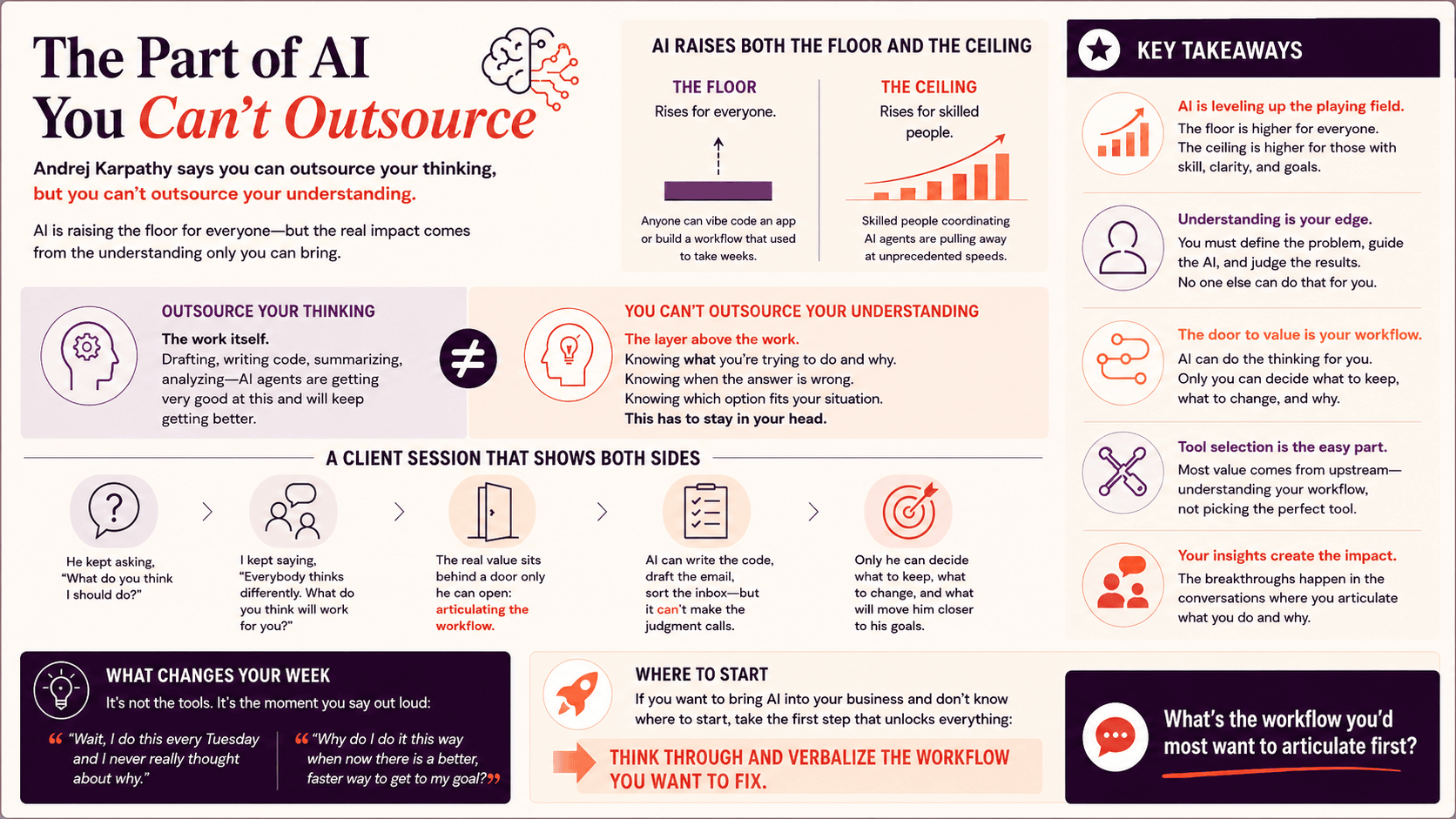
Andrej Karpathy says you can outsource your thinking, but you can't outsource your understanding. A recent client session showed me exactly what that looks like in practice.
During a recent Sequoia Capital fireside chat Andrej Karpathy said two things recently that I keep coming back to.
The first is that AI raises the floor and raises the ceiling at the same time. The floor rises because anyone can vibe code an app or stand up a workflow that would have taken weeks of engineering a year ago. The ceiling rises because skilled people coordinating these agents are pulling away at speeds that look nothing like the old “10x engineer” stories. Same tools, different outcomes depending on where you start and what your goals are.
The second is that you can outsource your thinking, but you can’t outsource your understanding. Think about that for a minute.
Thinking is the work itself. Drafting the email, writing the code, summarizing the meeting, working through the analysis. Agents are getting good at that part, and they’re going to keep getting better.
Understanding is the layer above. Knowing what you’re trying to do and why, knowing when the answer is wrong, knowing which option actually fits your situation (and which one fits a different business that happens to look like yours from the outside). That part has to stay in your head, because you’re the one steering the agent and judging the result. If you don’t understand the problem, you can’t direct the agent, and you can’t tell when it has drifted somewhere it shouldn’t have. And that is the important part whether you are an engineer, vibe coder or someone trying to use AI.
I had a session with a client recently that put both of these in front of me at the same time.
He kept asking, “what do you think I should do?”
I kept saying, “everybody thinks differently. What do you think will work for you?”
He asked again. I gave the same answer. It came up enough times in sessions that I need to to get even better at helping people through the process.
Here’s why I keep redirecting it. The floor really is low now. He could install connector or plugin tonight and have something working by morning. But the ceiling, the part where AI actually changes how his week feels, sits behind a door only he can open. The door is articulating the workflow. The steps, the decisions, the small judgment calls that make the work his.
That’s the understanding part. The agent is happy to do the thinking on his behalf. It will write the code, draft the email, sort the inbox, sketch the lightweight CRM. What it cannot do is decide which of his Tuesday morning rituals is worth keeping and which one was always a workaround for a problem that no longer exists. Only he knows that, and most of the time he doesn’t know he knows it until he says it out loud.
This is the part I see almost every client wrestle with. They show up assuming that picking AI tools is a tool-selection problem (the floor) when most of the value is upstream of the tools (the ceiling). Or that I can do all the work for them. A consultant who answers “automate X with Tool Y” without making them walk through their own process is selling them a tool, not a workflow. They’ll either bend their work to fit the tool or never adopt it at all and ultimately be dissatisfied.
The AI Workflow Assessment I run produces a recommendation document on the surface. The tools listed in it are downstream of the real work though. The thing that actually changes a client’s week is the moment in the session where they say out loud, “wait, I do this every Tuesday and I never really thought about why” or “why do I do it this way when now there is a better faster way to get to my goal”.
Karpathy’s framing makes this easier to talk about. The tools are raising the floor for everyone, thats good news. The hard part starts with understanding what you actually do and why.
If you’ve been wanting to bring AI into your business and you’re not sure where to start, the first move is thinking through and verbalizing the workflow you want to fix.
What’s the workflow you’d most want to articulate first?