AI isn't coming for your future. Fear is. - Analysis
This is an analysis of AI isn't coming for your future. Fear is. by Connor Boyack.
Executive Summary
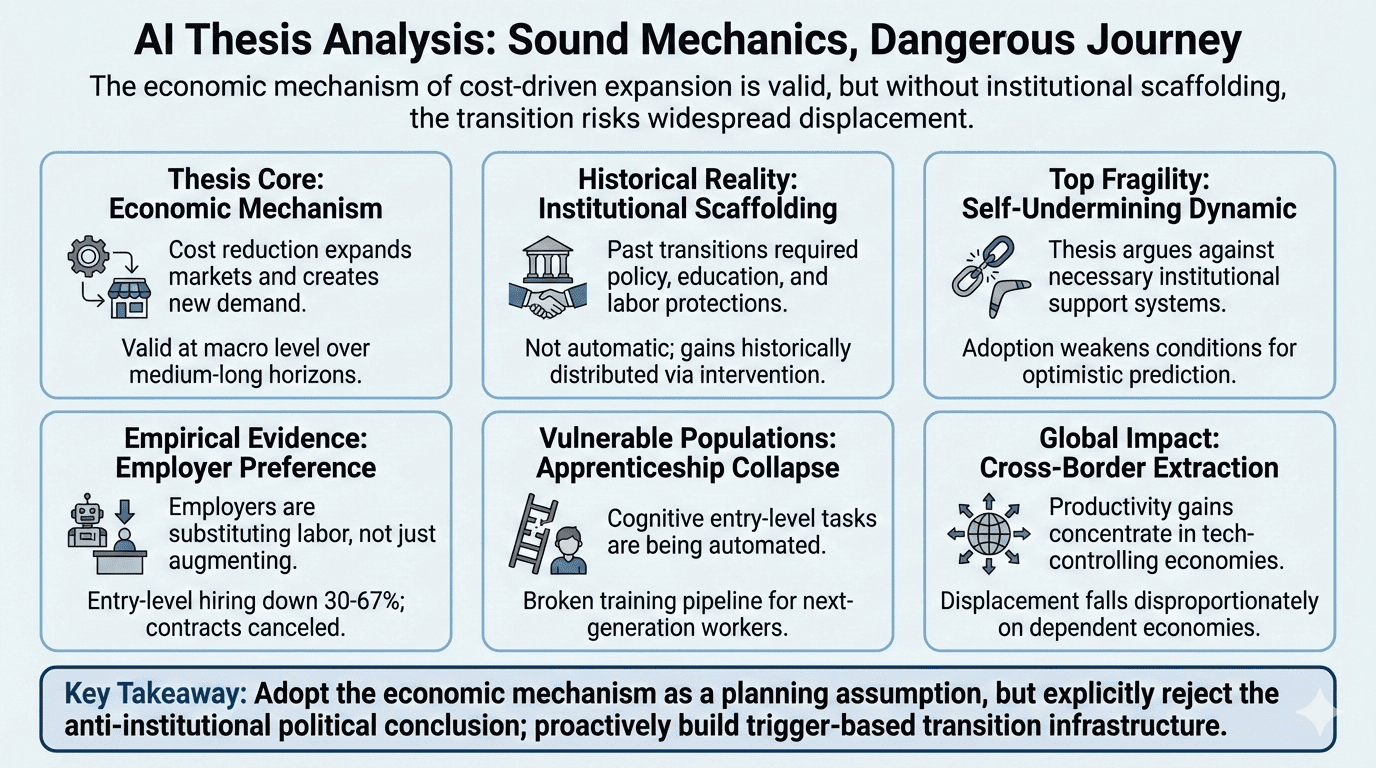
Connor Boyack’s thesis — that fear of AI displacement is a historically recurring cognitive error and that the real threat is mindset, not technology — survives multi-stakeholder scrutiny as a descriptive claim about recurring panic patterns and as a conditional macro-level prediction, but fails as prescriptive guidance and is actively harmful as a political argument against institutional intervention. Seven stakeholders across five debate rounds converged on a central finding: the thesis is not wrong about the destination but is dangerously wrong about the journey. Its core economic mechanism (cost reduction expands markets and creates new demand) is sound, but every historical case the thesis cites required institutional scaffolding — Factory Acts, compulsory education, labor unions, banking deregulation — to convert aggregate productivity gains into broad-based prosperity. The thesis argues implicitly against this scaffolding, creating a self-undermining dynamic where its own adoption weakens the conditions necessary for its optimistic prediction to hold. The most consequential empirical finding: employers are already acting as if AI substitutes for labor (entry-level hiring down 30-67%, BPO contracts being canceled), contradicting the thesis’s implicit claim that markets will spontaneously generate replacement roles. The thesis is most dangerous for populations bearing the highest transition costs with the least institutional support — mid-career displaced workers, Global South informal laborers, and new labor market entrants whose apprenticeship pipeline is collapsing.
Thesis
- Primary thesis: Fear of AI-driven job displacement is a historically recurring cognitive error rooted in Bastiat’s “seen vs. unseen” framework — people viscerally perceive immediate disruptions but systematically fail to foresee the vastly larger opportunities, industries, and human flourishing that new technologies create. AI will follow this same pattern, and the real threat is not the technology but the fearful mindset that prevents people from seizing its potential.
- Secondary claims:
- Bastiat’s 1850 “seen and unseen” distinction is the “master key” to AI doom narratives
- Every major technological disruption in the last 500 years followed the same pattern: panic, then expansion
- The “fixed-pie delusion” (treating the economy as zero-sum) is the core cognitive error
- The “this time is different” objection was made identically about computing in the 1960s
- Individual adoption, expanded ambition, and investment in uniquely human skills are the correct responses
- Implied goal: Readers shift from fear/resistance to proactive AI adoption and share the counter-narrative against viral AI doom content
- Interpretation notes: The document functions simultaneously as an economic argument, motivational call to action, and viral content instrument (explicitly asks for reposts). The analysis treats the economic/historical claim as the analytical thesis while noting that the prescriptive and political dimensions are inseparable from its rhetorical design.
Conflict Mapping
-
Direct conflicts:
- Entrepreneur vs. Displaced Worker on whether fear is cognitive error or rational assessment. Partially resolved: fear is individually rational but can produce collectively suboptimal outcomes if it drives pure paralysis rather than organized response.
- Thesis’s individual-agency framing vs. Policy Architect’s structural-conditions framing on whether outcomes depend primarily on individual mindset or institutional infrastructure. Resolved in favor of structural conditions with individual agency as necessary-but-insufficient complement.
- Global South Worker vs. Thesis’s historical examples on universalizability. The thesis’s examples (English textiles, US ATMs) demonstrate center-economy benefits while the same technologies produced peripheral-economy devastation (Indian weavers: 98% export decline). Unresolved — the thesis’s evidence, read completely, undermines its own universalist claim.
-
Alignment clusters:
- Institutional mediation cluster (Policy Architect, Workforce Transition Manager, Labor Economist, Global South Worker): Historical net-positive outcomes were co-produced by technology AND institutions; the thesis’s absence of policy architecture is its most consequential flaw.
- Vulnerability cluster (Displaced Worker, Global South Worker, Next-Gen Worker): Populations bearing disproportionate transition costs with least institutional support and least agency to adapt.
- Conditional optimism cluster (Entrepreneur, Next-Gen Worker): The mechanism is sound but scope conditions must be met; individual adoption is valuable but not sufficient.
-
Natural coalitions:
- Policy Architect + Workforce Transition Manager: Operational knowledge + policy design capacity. Both advocate trigger-based transition infrastructure.
- Next-Gen Worker + Global South Worker: Both face entry-level/apprenticeship pipeline collapse; both need generative policy (creating developmental pathways), not just redistributive policy (managing displacement).
- Entrepreneur + Policy Architect: Entrepreneur’s concession on asymmetric risk aligns with Policy Architect’s infrastructure investment case, despite different starting positions.
-
Irreconcilable tensions:
- Speed of deployment vs. speed of institutional response: AI deploys in quarters; retraining takes years; policy takes decades. No stakeholder identified a mechanism to close this gap within the thesis’s framework.
- Cross-border value capture: AI productivity gains accrue to technology-controlling economies while displacement falls on dependent economies. No governance mechanism exists to redistribute these gains globally, and the thesis provides no framework for even acknowledging this dynamic.
- Thesis’s political function vs. analytical content: The thesis’s rhetorical power derives from its simplicity and implicit anti-intervention stance. Adding the necessary scope conditions reverses its political valence entirely, making the “repaired” thesis a different argument.
Debate Highlights
-
Entrepreneur conceded asymmetric risk framework to Policy Architect
- What was at stake: Whether the thesis’s implicit argument against institutional investment is rational even on its own terms.
- What it revealed: Even the stakeholder most sympathetic to the thesis acknowledged that at 60% probability of correctness, the 40% failure case is catastrophically non-recoverable, making infrastructure investment the rational choice regardless. This effectively conceded the thesis’s political level (Level 4) from within the beneficiary’s own framework.
- Outcome: The entrepreneur shifted from “mechanism sound, scope underspecified” to “mechanism sound, AND the thesis’s political function actively undermines institutional preconditions for its own prediction.”
-
Global South Worker substantiated the cross-border displacement dynamic
- What was at stake: Whether the thesis’s historical examples support its universal claims or only its center-economy claims.
- What it revealed: India produced 25% of world textiles in the 17th century; by 1947, just 2%. The same mechanization that created prosperity in England destroyed India’s textile industry. The thesis cites English industrialization as evidence that “it always works out” while omitting that it catastrophically did not work out for the economy on the other side of the same disruption. AI replicates this center-periphery dynamic.
- Outcome: No stakeholder successfully rebutted this. The Entrepreneur and Transition Manager acknowledged the parallel while noting market-vs.-colonial-coercion distinctions that the Global South Worker argued are practically irrelevant.
-
Next-Gen Worker presented empirical evidence of the apprenticeship death spiral
- What was at stake: Whether AI’s impact on entry-level hiring is theoretical or already measurable.
- What it revealed: Junior dev postings down 67%, entry-level hiring at major tech firms down 50%+, only 30% of 2025 graduates secured field-relevant jobs, Dallas Fed documenting 13% employment decline for 22-25 year-olds in AI-exposed occupations. The thesis’s advice to “expand your ambition” presupposes a baseline of career capital that new entrants have never had the chance to build.
- Outcome: Policy Architect and Transition Manager challenged cyclical confounders (post-ZIRP correction) but ultimately conceded the structural component is significant (estimates: 40-70% structural). The apprenticeship death spiral was adopted as the highest-priority risk by the Transition Manager.
-
Workforce Transition Manager identified the institutional erosion loop
- What was at stake: Whether the thesis’s adoption creates a self-fulfilling prophecy of institutional failure.
- What it revealed: Thesis adoption → weakened case for policy intervention → fewer safety nets → more dislocation → political backlash → blunt, poorly designed interventions → interventions fail → “proof” that institutional intervention is counterproductive → reinforced thesis. The loop converts policy design failure into apparent evidence for the thesis’s anti-institutional stance.
- Outcome: Independently validated by the Entrepreneur’s “self-undermining dynamic” and the Policy Architect’s “epistemic closure” concept. Three stakeholders arriving at the same structural insight from different vantage points constitutes the strongest cross-stakeholder validation in the analysis.
-
Policy Architect’s epistemic closure warning
- What was at stake: Whether the thesis impairs the system’s ability to detect its own failure.
- What it revealed: If the thesis convinces policymakers that “the pattern always holds,” they stop collecting the data that would tell them when it doesn’t. BLS occupational surveys already lag 12-24 months. By the time deviation from the historical pattern is statistically confirmed, affected workers have been unsupported for 1-2 years. The thesis creates the most dangerous information asymmetry: self-reinforcing epistemic closure that reduces the system’s ability to detect when intervention is needed.
- Outcome: No stakeholder rebutted this. The Entrepreneur incorporated it into their revised position.
Key Falsifiers
Consolidated from all stakeholder cards and grouped by what they test.
Thesis Viability (Macro-Level Prediction)
- Spontaneous labor absorption rate: If >70% of AI-displaced workers find comparable-wage employment within 12 months without government retraining or transition support, the thesis’s individual-agency framing is vindicated. (Policy Architect. Measurement: BLS Displaced Worker Survey.)
- New occupation creation velocity: If BLS shows net new occupation categories absorbing 50%+ of displaced workers within 5 years, the “unseen” opportunity claim is supported at macro level. (Policy Architect.)
- Median wage trajectory post-displacement: If AI-displaced workers experience >20% median wage decline sustained 3+ years, the thesis’s promise of “better, more human work” is falsified. (Workforce Transition Manager.)
Implementation Feasibility (Transition Mechanics)
- Retraining conversion rate: If <40% of corporate AI retraining completers secure comparable-wage employment within 24 months, the individual-adaptation prescription fails. (Workforce Transition Manager.)
- Time-to-reemployment: If median exceeds 18 months for AI-displaced knowledge workers by 2028, the “brief transition” assumption is falsified. (Workforce Transition Manager.)
- Corporate investment ratio: If retraining spending falls below 5% of AI deployment spending industry-wide, employers are not investing in adaptation — revealed preference contradicting the thesis. (Workforce Transition Manager.)
- AI tool stability: If core AI tools remain functionally stable 18+ months, training programs can design durable curricula; if not, the skill treadmill prevents meaningful retraining. (Policy Architect.)
Entry-Level Pipeline
- Entry-level job postings: If knowledge-work entry-level postings recover to 2019 levels by 2029, the apprenticeship death spiral is not structural. If they do not, the career development pipeline is broken. (Next-Gen Worker, adjusted baseline per Policy Architect challenge.)
- New job category creation for new entrants: If by 2029, at least three genuinely new job categories exist that (a) didn’t exist before 2024, (b) employ 100K+ US workers, and (c) are accessible with <5 years experience, the “unseen opportunities” claim is supported for new workers. (Next-Gen Worker.)
- AI wage premium decay: If generalist AI-user wage premium (currently 56%) falls below 15% by 2029, commodification spiral confirmed and AI fluency becomes table stakes rather than competitive advantage. (Next-Gen Worker.)
Global South / Cross-Border Effects
- AI adoption gap: If Global North-South gap (currently 10.6pp) narrows below 8pp by 2028, leapfrog scenario gains credibility. (Global South Worker. Measurement: Microsoft annual surveys, ITU data.)
- Philippine BPO employment: If direct employment falls below 1.4M from current 1.5-1.7M baseline by 2028, structural displacement confirmed in the thesis’s own “ATM teller” analog. (Global South Worker. Measurement: PSA labor surveys, IBPAP reports.)
- No Engels’ Pause: If real wages for bottom two quintiles in Philippines, Kenya, Bangladesh grow at least as fast as GDP per capita over 2025-2030, distributional harm is not materializing. (Global South Worker. Measurement: World Bank income data.)
- Net new AI-created roles in Global South: If by 2030, genuinely new AI-created roles employ >500K workers in Global South at wages above displaced-sector medians, the cross-border displacement thesis is weakened. (Global South Worker.)
Stakeholder Cooperation / Institutional Response
- Fiscal non-deterioration: If state UI trust funds and federal workforce development budgets do not deteriorate correlated with AI adoption rates over 5 years, fiscal erosion loop is not operating. (Policy Architect.)
- Geographic concentration: If any metropolitan area experiences AI-related job losses exceeding 15% of total employment without replacement within 5 years, a “new Rust Belt” has formed. (Workforce Transition Manager.)
- Capital-labor gains ratio: If AI productivity gains captured by capital vs. labor exceed 90:10 for 5 consecutive years, the “everyone benefits” claim is falsified even if GDP grows. (Workforce Transition Manager.)
Assumptions Audit
| # | Assumption | Plausibility | Supporting Evidence | Undermining Evidence |
|---|---|---|---|---|
| 1 | AI will follow the same macro pattern as previous GPTs (net employment growth) | Moderate | 500 years of GPT history; robust mechanism (cost reduction → demand expansion) | Speed and breadth unprecedented; simultaneous disruption of cognitive, creative, and service work; no prior GPT threatened the cognitive “escape hatch” |
| 2 | Individual adaptation is sufficient for successful transition | Weak | Some workers demonstrably thrive with AI tools; tools are genuinely accessible and cheap | Structural constraints (age, geography, capital, networks) dominate outcomes; adaptive capacity not uniformly distributed; employer revealed preference shows substitution not augmentation |
| 3 | The “unseen” opportunities will materialize on policy-relevant timescales (3-10 years) | Moderate-Weak | Historical examples show eventual creation; some new AI-enabled roles already emerging | Historical “eventually” was decades to generations; the Luddite-era transition involved 40-50 years of immiseration; no evidence creation will match destruction speed |
| 4 | The historical pattern applies globally, not just in technology-controlling economies | Weak | Some Global South economies (Kenya tech, Philippine BPO) captured value from earlier tech waves | Indian textile collapse under British industrialization; colonial extraction pattern; 2.6B offline; widening AI adoption gap; Global South positioned as inputs not beneficiaries |
| 5 | Fear is the primary barrier to adaptation | Weak | Fear can produce paralysis; some workers who overcome fear do adapt successfully | Structural constraints (capital, access, infrastructure, age, networks) are primary barriers; fear is a rational response to material threat, not a cognitive error |
| 6 | Tools are “cheap, most are free” with a “gentler learning curve” | Moderate in Global North, Weak globally | Free tiers exist; natural language interfaces lower technical barriers | Premium models increasingly gated; requires reliable electricity, broadband, modern device, English fluency; 2.6B offline; effective use requires domain knowledge tools cannot provide |
| 7 | The economy creates new value rather than merely redistributing | Strong at aggregate, Weak at distributional | Every historical GPT expanded total economic output | New value can concentrate among capital owners and high-skill workers; “the garden grows” but not uniformly; rain doesn’t fall equally |
System Stability
-
Reinforcing loops (driving toward thesis’s optimistic scenario):
- Cost collapse → demand expansion → new markets → new roles (the core mechanism; historically robust but requires institutional mediation)
- Early AI adoption → productivity gains → competitive advantage → further adoption → market expansion
- Cheaper services → broader access → new consumer segments → new businesses serving those segments
-
Countervailing forces (pushing against the thesis):
- Apprenticeship death spiral: AI eliminates entry-level cognitive tasks → broken training pipeline → skill deficit in 5-10 years → increased AI dependency → further entry-level elimination
- Automation-of-the-automators: Global South workers train AI → AI automates their tasks → workers displaced with no organizational recourse → self-consuming labor input
- Wage compression: AI democratizes “good enough” output → market price drops → workers rely more on AI for throughput → quality converges → prices drop further
- Institutional erosion: Thesis adoption → weakened policy case → fewer safety nets → more dislocation → backlash → blunt interventions → interventions fail → “proof” against institutional response
- Epistemic closure: Thesis frames concern as “fear” → reduced monitoring investment → deviations go undetected → delayed response → worse outcomes attributed to insufficient adaptation rather than insufficient support
- Fiscal erosion: AI displaces payroll-tax-generating employment → reduced revenue for safety nets → benefit cuts when claims increase → deeper hardship
-
Unrealistic cooperation requirements:
- The thesis assumes employers will invest in workforce transition voluntarily. Employer revealed preference (cutting headcount, increasing AI spending) contradicts this assumption.
- Cross-border gains distribution would require international coordination mechanisms that do not exist. No governance framework addresses AI’s center-periphery value extraction.
- The “expand your ambition” advice requires simultaneous access to tools, capital, networks, domain knowledge, and psychological safety margins — a combination available to a minority of affected workers.
-
Scaling fragility:
- The thesis’s mechanism works well for individual early adopters and small-scale disruption. It has not been tested at the speed and breadth AI imposes — simultaneous disruption across all cognitive-work sectors, globally, in months rather than decades.
- Retraining infrastructure designed for incremental occupational shifts cannot absorb simultaneous multi-sector displacement. Organizations can retrain and redeploy limited numbers of workers simultaneously.
- The solo-founder model works at small scale but produces winner-take-all dynamics at scale — each successful solo founder who replaces 15-20 workers concentrates rather than distributes gains.
Top Fragilities
-
The self-undermining dynamic (severity: 9/10, category: coordination_failure) The thesis’s political function — arguing against institutional intervention — actively undermines the institutional conditions its own historical examples required. If widely adopted, it produces the policy vacuum that makes catastrophic outcomes more likely, while simultaneously discouraging the monitoring that would detect the problem.
-
Speed-of-displacement vs. speed-of-creation mismatch (severity: 9/10, category: assumption_failure) AI deploys in quarters. Retraining takes years. Policy takes decades. New industries take decades to absorb displaced workers at scale. The thesis acknowledges speed as a difference but dismisses its implications. If creation lags destruction by even 5 years, the transition trough produces irreversible human costs.
-
Entry-level pipeline collapse (severity: 8/10, category: constraint_bottleneck) Junior dev postings down 67%, entry-level tech hiring down 50%+. If the cognitive apprenticeship pipeline is broken, the workforce cannot develop the “uniquely human” skills the thesis prescribes. The thesis’s own solution (invest in judgment, creativity, relationship skills) requires developmental pathways that AI is eliminating.
-
Cross-border value extraction without redistribution (severity: 8/10, category: coordination_failure) AI productivity gains concentrate in technology-controlling economies while displacement falls on dependent economies (Philippines BPO $35B, India IT $245B, Bangladesh garments $45B). No governance mechanism exists to address this. Historical parallel: English industrialization devastated Indian textiles for over a century.
-
Epistemic closure (severity: 7/10, category: assumption_failure) The thesis discourages the monitoring and measurement that would detect deviation from the historical pattern. BLS data already lags 12-24 months. By the time statistical evidence of failure accumulates, affected populations have been unsupported for years.
-
Fiscal erosion of safety nets (severity: 7/10, category: external_shock) AI displacement reduces payroll tax revenue that funds unemployment insurance and social security. Safety net capacity degrades precisely when demand increases. Global South economies face this at national scale — Philippines BPO generating 7.4% of GDP; Bangladesh garments ~15%.
-
Narrative capture (severity: 6/10, category: coordination_failure) The thesis functions as a rhetorical instrument that delegitimizes worker resistance and collective action by labeling concerns as “Luddite” and “fear-driven.” Workers who organize for transition support can be dismissed as suffering from a “cognitive error.” This suppresses the political mobilization that historically produced the institutional responses the thesis’s own examples required.
Conditional Thesis
-
Surviving thesis: Technology-driven cost reduction tends to expand markets and create new economic value over medium-to-long time horizons, and AI is likely to follow this pattern in aggregate. However, this outcome is not automatic — it has historically required institutional mechanisms (education, labor protections, safety nets, competition policy, infrastructure investment) to distribute gains broadly. For workers and economies lacking these mechanisms, disruption can produce lasting immiseration, as it did for Indian weavers under British industrialization and American manufacturing workers under deindustrialization. AI’s unprecedented speed and breadth make these institutional mechanisms more urgent, not less. Individual adaptation is necessary but insufficient; fear is a rational signal to be channeled into institutional response, not a cognitive error to be overcome through attitude adjustment.
-
Conditions that must hold:
- Institutional transition infrastructure (retraining, portable benefits, extended UI, monitoring systems) is built during the critical 0-5 year window, not after displacement is politically undeniable
- New occupation creation matches or exceeds displacement pace within policy-relevant timeframes (5-10 years, not 20-50)
- Entry-level and apprenticeship pipelines are deliberately maintained or rebuilt through employer incentives, public programs, or new institutional forms
- Cross-border gains distribution receives at minimum bilateral attention (tech-economy governments negotiating transition support with dependent economies)
- AI capability gains do not close the cognitive “escape hatch” — there remain meaningful categories of work where human judgment, creativity, and relationship skills provide durable comparative advantage
- Monitoring and measurement systems track displacement in real time, with automatic policy triggers when falsifiers are breached
Unresolvable Tradeoffs
| Tradeoff | Who Loses | Normative Commitment Required |
|---|---|---|
| Speed of AI deployment vs. manageable transition pace | Workers displaced before institutional response can form | Society must accept either slower deployment (reduced innovation gains) or higher public spending on transition support (fiscal cost) |
| Aggregate economic growth vs. distributional equity | Workers whose roles are eliminated in sectors/geographies that do not recover | Society must accept that “the economy grew” is insufficient justification if identifiable populations bear permanent costs |
| Technology-controlling economy gains vs. dependent-economy losses | Global South workers in BPO, data labeling, garment manufacturing | International community must either build redistribution mechanisms or accept a new center-periphery extraction dynamic |
| Entry-level pipeline maintenance vs. firm-level cost optimization | Next-generation workers who need apprenticeship pathways | Employers must accept some inefficiency in maintaining junior roles, or public systems must substitute for employer-provided training |
| Individual freedom to adopt AI rapidly vs. collective need for managed transition | Either early adopters (if deployment is slowed) or displaced workers (if deployment is unconstrained) | Society must choose a point on the speed-equity frontier and accept the associated cost |
Decision Guidance
Recommended Action
Adopt the thesis’s core mechanism (technology creates new value) as a planning assumption while explicitly rejecting its political conclusion (institutional intervention is unnecessary). Build trigger-based transition infrastructure — automatic stabilizers that activate when displacement metrics cross thresholds and sunset when metrics normalize. This avoids both the thesis’s error (no infrastructure) and the opposite error (permanent bureaucracy for a potentially transient problem).
Conditions Under Which This Holds
- AI displacement is occurring at pace and scale that exceeds normal labor market absorption (current evidence: entry-level hiring down 30-67%, BPO contracts being canceled, employer revealed preference toward substitution)
- The institutional mediation pattern from historical technology transitions (Factory Acts, GI Bill, Riegle-Neal Act) is genuinely necessary for broad-based prosperity, not merely coincidental
- Political systems retain capacity to build proactive infrastructure before backlash-driven reactive interventions become the only option
If Those Conditions Fail
- If AI displacement proves slow and diffuse (normal labor market churn absorbs it within 5 years without intervention) → the trigger-based infrastructure activates minimally and costs are modest; the asymmetric risk framework means this outcome is acceptable
- If the thesis proves correct at all four levels (individual adaptation genuinely sufficient) → transition infrastructure exists but is not heavily utilized; fiscal cost is recoverable
- If AI displacement proves catastrophic and rapid (faster than even trigger-based infrastructure can respond) → emergency measures required; the critical investment is in monitoring systems that detect this scenario early enough to escalate response
Falsifier Watchlist
Monitor these indicators — if any trigger, revisit this guidance:
- Entry-level knowledge-work postings — if they fail to recover to 2019 levels by 2029, the apprenticeship pipeline is structurally broken (escalate: new-entrant pipeline intervention)
- Median time-to-reemployment for AI-displaced workers — if it exceeds 18 months by 2028, transitions are not self-correcting (escalate: extended income support)
- Philippine BPO employment — if it falls below 1.4M by 2028, cross-border displacement is accelerating without institutional response (escalate: international coordination)
- Corporate retraining-to-deployment spending ratio — if below 5%, employers are not investing in the transition they are causing (escalate: mandatory employer contributions)
- Capital-labor gains ratio — if above 90:10 for 3+ years, value concentration is producing the distributional failure the thesis denies (escalate: redistribution mechanisms)
Blind Spots & Limitations
- Stakeholder categories not represented: Category 5 (Competitors/adversaries — e.g., legacy service providers threatened by AI-enabled competitors) and Category 6 (Capital providers/investors — VC and corporate investors driving AI deployment decisions). The absence of an employer stakeholder was identified by the Next-Gen Worker as the most consequential gap — employer revealed preference (cutting headcount while increasing AI spending) is the most informative data point in the analysis, and no stakeholder represents the decision-makers driving this behavior.
- Data or context gaps: The Displaced Knowledge Worker and Labor Economist provided analyses that were not fully visible to the coordinator in all rounds, potentially underrepresenting their contributions. Real-time AI displacement data is sparse — BLS surveys lag 12-24 months, and informal-sector displacement (Global South) is structurally unmeasured. The cyclical vs. structural decomposition of entry-level hiring decline remains imprecise (estimates ranged from 40-70% structural).
- Ungrounded claims: The thesis’s claim that “every single time” technology transitions produced net-positive outcomes was challenged but could not be fully verified or falsified within this analysis. The colonial Indian textile destruction data (25% → 2% of world production) was cited from historical literature but not independently verified. AI-specific displacement projections remain speculative — no stakeholder could precisely predict the pace or scale of displacement.
- Scope boundaries: This analysis did not examine: AI safety/alignment risks (existential risk); environmental costs of AI compute infrastructure; intellectual property and creative-work displacement specifically; the role of open-source AI in potentially democratizing access; China’s AI development trajectory and geopolitical implications; or the possibility that AI capability hits fundamental limits that slow displacement. Each of these could significantly alter the analysis if incorporated.
Appendix: Stakeholder Cards
Solo AI-Augmented Entrepreneur
Identity & Role
A founder leveraging AI to build what previously required a team of 15-20. Direct beneficiary of cost collapse. Living proof of the “unseen” opportunity the thesis describes, but transparent about survivorship bias and the limits of their perspective.
Thesis Interpretation
The thesis packages a sound economic mechanism inside a political argument against institutional intervention that is contradicted by its own evidence. The mechanism (cost collapse → demand expansion) is real and experienced first-hand. But the thesis functions as a narrative instrument that flatters beneficiaries while pathologizing the constraints of those who bear transition costs.
Steelman Argument
AI dramatically reduces the cost of producing goods and services, which expands addressable markets, creates demand that didn’t previously exist, and enables individuals to create value at scales previously reserved for organizations. This is the same mechanism that drove post-industrial prosperity, and there is no strong reason to believe it has stopped operating. Early adopters who experiment with AI tools will disproportionately capture the value of this expansion.
Toulmin Breakdown
Claim
AI-driven cost collapse will expand markets and create net new economic value, as previous general-purpose technologies have done.
Grounds
Historical precedent (ATMs, spreadsheets, power looms); personal experience replacing a 15-20 person team; the mechanism of cost reduction → demand expansion is well-documented.
Warrant
If a pattern has held across every major GPT for 500 years and the underlying mechanism remains intact, the default expectation should be continuity.
Backing
Mainstream economic theory on creative destruction (Schumpeter), comparative advantage, and general-purpose technologies. Bessen’s ATM research. Bastiat’s framework.
Qualifier
The pattern holds in aggregate, over medium-to-long horizons (10-30 years), at the macro level. It does not hold uniformly across geographies, demographics, or time horizons. Survivorship bias in personal testimony. Composition fallacy risk (individual success ≠ universal benefit).
Rebuttals
Survivorship bias; composition fallacy (entrepreneur’s gain may be 19 others’ loss); speed-of-disruption risks; uneven capital requirements; winner-take-all concentration dynamics.
Gains & Losses
Concentrated gains for AI-fluent individuals with existing capital. Diffuse losses for displaced workers. Self-undermining dynamic: if thesis is used to argue against institutional support, it makes its own optimistic prediction less likely.
Power and Status Shifts
Power flows toward AI-fluent individuals with capital, platform companies, and optimist-narrative creators. Away from organized labor, regulatory bodies, and Global South workers.
Constraints
Time compression (institutional response speed vs. disruption speed); skill-ceiling (where is the next retraining escape hatch?); infrastructure (2.6B people offline); winner-take-all dynamics at scale.
Cognitive Biases and Information Asymmetries
Susceptible to survivorship bias, optimism bias, and narrative bias. Acknowledged that fear-side biases (loss aversion, availability heuristic) also distort discourse.
Feedback Loops
Solo-founder proliferation loop (reinforcing, self-limiting via commoditization); narrative-policy loop (most dangerous — optimist success stories suppress infrastructure investment); entry-level extinction loop; global south extraction loop.
Externalities
Positive: consumer surplus from cheaper services, entrepreneurial ecosystem expansion. Negative: displaced workers bear costs of the entrepreneur’s efficiency gains; each solo founder eliminates potential junior positions.
Time Horizons
Short (0-2 years): maximum opportunity for early adopters, maximum danger for displaced workers. Medium (3-7 years): thesis faces empirical test. Long (8-20 years): most likely directionally correct at macro level.
Likely Actions
Continue building with AI tools while privately hedging (diversifying, maintaining human relationships as backup). Publicly advocate for the thesis while privately acknowledging its limitations.
Falsifiers
Solo-founder proliferation doesn’t create net new employment by 2030; entrepreneur’s own hedging behavior as revealed-preference test; demand elasticity doesn’t operate fast enough to prevent multi-generational poverty traps.
Displaced Mid-Career Knowledge Worker
Identity & Role
A 45-year-old copywriter/analyst whose daily tasks have been automated in months, not decades. The human face of “the seen.” Has a mortgage, family, and skills that took decades to build. The person the doom articles are written about.
Thesis Interpretation
The thesis pathologizes legitimate concern. It dismisses fear as a cognitive error when it is a rational response to material threat. It provides rhetorical cover for employers to externalize transition costs. The “seen” isn’t a perception error — it’s real people losing real livelihoods.
Steelman Argument
The strongest version: historical evidence shows transitions eventually produce net-positive outcomes, and individual workers who adopt new tools tend to fare better than those who resist. Engaging with AI rather than refusing it is sound survival advice.
Toulmin Breakdown
Claim
Fear of displacement is rational, not a cognitive error, and the thesis’s framing of it as irrational is both analytically wrong and morally objectionable.
Grounds
Material threat is real and immediate; professional identity destruction produces grief comparable to bereavement; structural constraints (age, geography, financial obligations) limit adaptive capacity independently of mindset.
Warrant
When observable evidence confirms a threat to livelihood, responding with concern is rational threat assessment, not cognitive failure.
Backing
Decades of labor economics research showing displacement outcomes correlate with structural factors (age, geography, industry concentration, labor market thickness) more than individual attitudes.
Qualifier
Individual fear, however rational, does not automatically translate to optimal collective response. Paralysis is a real risk.
Rebuttals
The thesis is correct that passivity produces worse outcomes than engagement; fear can become self-fulfilling if it prevents all adaptation.
Gains & Losses
The thesis’s adoption provides motivational framing but also provides cover for employers to externalize costs. Workers who fail internalize blame when actual constraints are structural.
Power and Status Shifts
Narrative power shifts to those who survived (the author, entrepreneurs). Displaced workers whose struggles are reframed as attitudinal failures lose the rhetorical leverage to demand institutional support.
Constraints
Age discrimination, geographic immobility, financial obligations (mortgage, family), compressed timeline, professional identity loss, psychological safety margin for experimentation.
Cognitive Biases and Information Asymmetries
The thesis exhibits fundamental attribution error (attributing displacement outcomes to individual disposition rather than structural conditions). Firms know deployment timelines 12-24 months ahead of workers.
Feedback Loops
Blame internalization loop: structural failure → individual blame → reduced collective action → less institutional support → more structural failure. Fear-paralysis loop: rational fear → reduced experimentation → worse outcomes → confirms thesis that “fear is the problem.”
Externalities
Healthcare costs from displacement-related depression, anxiety, substance abuse. Community destruction when displacement concentrates geographically. Social safety net burden externalized from employers to public systems.
Time Horizons
Short (0-2 years): maximum personal crisis. Medium (3-7 years): reemployment or permanent exit from prior career track. Long: largely determined by policy choices made during the short-medium window.
Likely Actions
Attempt adaptation while managing financial obligations; seek retraining if available and affordable; potential political mobilization for transition support; risk of demoralization and labor market exit.
Falsifiers
If >70% of displaced mid-career workers achieve comparable-wage reemployment within 12 months without institutional support, individual-agency framing is vindicated. If median wage decline post-displacement <10%, the thesis’s promise of “better work” has merit.
Workforce Transition Manager
Identity & Role
HR/operations leader managing retraining, redeployment, and layoffs during AI adoption. Reports to C-suite wanting faster adoption while facing a workforce ranging from enthusiastic to terrified. Measured on contradictory metrics: speed of AI integration and employee retention/morale.
Thesis Interpretation
“Directionally useful but dangerously incomplete.” The optimistic framing combats paralysis and helps secure retraining budgets. But the thesis implies the transition is self-correcting, individual agency is the primary variable, and institutional responsibility is secondary. The essay treats the space between “jobs lost” and “new jobs created” as a footnote — from the transition manager’s perspective, that space is the entire problem.
Steelman Argument
Historical evidence shows technological displacement is temporary and net-positive over medium-to-long horizons. The ATM case is instructive: automation of core banking function expanded the market. AI fits this pattern. Organizational energy should flow toward adoption and adaptation rather than resistance. Investing in retraining produces better outcomes than delay.
Toulmin Breakdown
Claim
AI displacement will likely follow the historical pattern of net-positive outcomes, but only if transition infrastructure is deliberately built.
Grounds
Historical induction; ATM/teller data (Bessen); mechanism of cost reduction → market expansion; operational observation that some AI-complementary roles are genuinely emerging.
Warrant
The mechanism is robust but historically required institutional mediation (Riegle-Neal Act for ATMs, Factory Acts for textiles).
Backing
James Bessen’s research explicitly showing institutional context (banking deregulation) as necessary complement to ATM technology.
Qualifier
Pattern holds in aggregate over 10-30 years, not uniformly across demographics, geographies, or short timescales. Speed and breadth of AI may compress the transition beyond institutional response capacity.
Rebuttals
Transition cost problem; skill-ceiling problem (AI threatens the cognitive escape hatch); agency asymmetry; pace-of-creation lag; survivorship bias in personal testimony.
Gains & Losses
Thesis gives political capital for retraining budgets but also provides cover for companies that want productivity gains while externalizing transition costs. “AI upskilling” programs with modest budgets used to justify layoffs.
Power and Status Shifts
From labor to capital; from transition managers to AI implementation teams; from experienced workers to AI-native workers; from workers in Global South to platform owners in Global North. Narrative power delegitimizes worker resistance.
Constraints
Retraining costs $10K-30K/worker over 6-18 months; absorptive capacity (can’t place 200 retrained workers into 50 roles); timeline mismatch (AI deploys in quarters, retraining takes years); identity destruction in workers; learning capacity variance; AI capability uncertainty preventing planning.
Cognitive Biases and Information Asymmetries
Survivorship bias in thesis; temporal discounting of transition suffering; composition fallacy; just-world hypothesis. Information asymmetries: leadership vs. workforce (deployment roadmaps); vendors vs. buyers (capability overstatement); current vs. projected AI capability (radical uncertainty).
Feedback Loops
Retraining credibility spiral (failed programs erode trust → lower enrollment → blamed on workers → budget cuts); productivity-displacement ratchet; vendor-adoption acceleration; narrative legitimation loop; institutional erosion loop (most dangerous — policy failure generates evidence reinforcing the thesis).
Externalities
Healthcare costs from displacement-related suffering; social safety net burden; community destruction; skill-development infrastructure decay; consumer surplus from cheaper services (positive but doesn’t offset individual losses).
Time Horizons
Short (0-2 years): maximum operational pressure, highest danger if thesis taken literally. Medium (3-7 years): thesis faces empirical test, absorptive capacity becomes binding. Long (8-20 years): thesis most likely directionally correct at macro level, but distributional outcomes determined by short/medium-term choices.
Likely Actions
Selective thesis adoption (optimistic framing for communications, skeptical framework for planning); accelerated internal labor market development; coalition building with policy stakeholder; data collection on actual outcomes; resistance to purely individual-agency framing.
Falsifiers
Retraining conversion rate <40%; time-to-reemployment >18 months by 2028; entry-level postings decline >30% from 2024 baseline by 2028; corporate retraining spending <5% of AI deployment spending; geographic concentration producing “new Rust Belt”; capital-labor gains ratio >90:10 for 5 years.
Labor Policy Architect
Identity & Role
Government policymaker designing safety nets, retraining programs, and regulatory frameworks. Agnostic on the endpoint, obsessive about the pathway. Responsible for the structural conditions that enable or prevent individual adaptation — conditions the thesis treats as invisible.
Thesis Interpretation
The thesis commits a policy-relevant omission as consequential as the cognitive error it diagnoses. It acknowledges transition costs (“bumpy”) but treats them as a footnote. For a policymaker, those costs are the entire domain of governance. Historical examples actually undermine the “technology alone” claim — net-positive outcomes were co-produced by technology AND institutional response.
Steelman Argument
Overly restrictive policy responses pose a greater threat than the disruption itself. If policymakers respond with protectionism — licensing barriers, deployment moratoriums, punitive automation taxes — they risk replicating Elizabeth I’s refusal of the knitting machine. The rational policy posture is to facilitate adaptation rather than resist transformation.
Toulmin Breakdown
Claim
Fear-driven responses are more dangerous than disruption itself, AND the historically recurring pattern of net-positive outcomes will hold — BUT only with deliberate institutional support.
Grounds
Historical cases; Bastiat framework; mechanism of cost reduction → market expansion; personal testimony.
Warrant
Historical induction + assumption that freed-up human effort reliably redirects toward higher-order problems when institutional scaffolding supports the transition.
Backing
175 years of industrialization history; Bessen’s ATM research; mainstream economic theory on creative destruction and comparative advantage.
Qualifier
The historical pattern holds only when accompanied by institutional interventions (Factory Acts, compulsory education, labor unions, banking deregulation). The thesis treats these as background noise; they are foreground conditions.
Rebuttals
The transition gap is the policy problem, not the endpoint; historical outcomes were policy-mediated; speed and breadth matter for policy design; individual agency presupposes structural conditions; the “fixed-pie” critique cuts both ways (gardens need irrigation, not just rain).
Gains & Losses
Thesis provides intellectually respectable justification for policy inaction — mirrors Rust Belt “market will adjust” approach that produced the opioid crisis. If thesis suppresses infrastructure investment during critical early phase, capacity to respond later degrades (asymmetric risk: unnecessary infrastructure is recoverable; missing infrastructure is not).
Power and Status Shifts
From labor to capital; policymakers lose decision space (proposals coded as “Luddite”); credentialing institutions lose authority; narrative power concentrates among survivors.
Constraints
Legal frameworks not designed for diffuse, rolling displacement; fiscal constraints (WIOA ~$700M annually, inadequate for AI-scale transition); institutional lag (curriculum development 12-18 months); BLS data lag 12-24 months; regulatory arbitrage between jurisdictions.
Cognitive Biases and Information Asymmetries
Survivorship bias at historical scale (curated dataset); optimism bias and anchoring on endpoints; fundamental attribution error at scale (“refuse to change”). Asymmetries: firms know deployment timelines ahead of workers; AI companies know capability trajectories ahead of policymakers; thesis creates self-reinforcing epistemic closure.
Feedback Loops
Inaction-crisis-overreaction cycle; epistemic closure loop; fiscal erosion loop; skill treadmill loop; regulatory arbitrage loop (international race to bottom).
Externalities
Health system costs (“deaths of despair” pathway); democratic legitimacy erosion; educational system disruption (stranded credential investments). Positive: consumer surplus from cost reduction; entrepreneurial ecosystem expansion.
Time Horizons
Short (0-3 years): critical infrastructure investment window; thesis appears correct because neither harm nor new industries yet measurable. Medium (3-10 years): displacement becomes statistically visible; fiscal erosion loop most dangerous. Long (10-30 years): composition of benefiting workforce determined by short/medium choices.
Likely Actions
Push for mandatory AI deployment impact reporting; redesign UI triggers; create Technology Transition Adjustment Assistance (TTAA); build cross-stakeholder coalitions; resist thesis framing without adopting protectionism.
Falsifiers
Spontaneous labor absorption >70% without support; new occupation creation matching displacement pace within 5 years; demographic uniformity in outcomes; AI tool stability for 18+ months; fiscal non-deterioration; Philippine BPO employment holds above 1.4M.
Global South Informal Economy Worker
Identity & Role
Data labeler in Nairobi, call center agent in Manila, garment worker in Dhaka, delivery rider in Lagos. Interacts with AI daily — often as the invisible human labor behind it (training data, content moderation) or as the worker most immediately replaceable by it. Defining conditions: no unemployment insurance, no severance, limited broadband, payment in depreciating currencies, dependence on platforms in jurisdictions they cannot influence.
Thesis Interpretation
The thesis is a prescription written for a patient the author has never examined. Every historical example occurred within nations possessing strong property rights, functioning courts, public education, capital markets, and social safety nets. The thesis implicitly universalizes Anglophone institutional conditions without acknowledging that universalization.
Steelman Argument
AI lowers barriers to economic participation. Mobile-first AI applications could reach populations desktop software never did. M-Pesa demonstrated developing economies can leapfrog infrastructure gaps. Some Global South workers can move up the value chain using AI tools. Fear-based regulation could lock Global South workers out of the one lever that might reduce the productivity gap.
Toulmin Breakdown
Claim
AI will follow the historical pattern — but only within economies that develop institutional mechanisms for distributing value. For economies lacking these mechanisms, disruption can produce lasting immiseration.
Grounds
Historical precedent shows the pattern holds in controlling economies; counter-examples (colonial Indian weavers: 25% → 2% of world textiles) show it fails in dependent economies.
Warrant
The causal mechanism requires institutional conditions (education, labor protections, safety nets, infrastructure) that are not present in much of the Global South.
Backing
IMF findings on AI exposure in developing economies; Microsoft data on widening adoption gap (10.6pp); colonial Indian textile data; Philippine BPO structural dependency data ($35B, 1.7M workers).
Qualifier
Leapfrog potential is non-zero; open-source AI and mobile-first applications could partially close the gap; some Global South workers will successfully adapt.
Rebuttals
Institutional gap is causal not cosmetic; Global South workers positioned as inputs not beneficiaries; “use the tools” assumes access the thesis doesn’t verify; speed of disruption creates humanitarian crises without safety nets; the “fixed pie” metaphor obscures distributional reality.
Gains & Losses
Gains concentrated among 10-15% minority with English, connectivity, digital skills. Losses fall on data labelers (~2M globally), BPO workers (Philippines 1.7M), garment workers (Bangladesh $45B industry), platform gig workers. Net loss calculation stark: losers more numerous, more vulnerable, fewer alternatives.
Power and Status Shifts
Power flows to compute owners and away from Global South labor. National governments lose regulatory leverage against cloud-delivered AI. The thesis itself functions as a power instrument — delegitimizing demands for regulation and transition funding.
Constraints
Infrastructure (2.6B offline, 4000+ hrs/yr power outage in Nigeria); capital ($200-500 device = weeks of income); language (English-first tools); structural dependency (Philippines BPO 7.4% of GDP, Bangladesh garments ~15%); psychological safety margin eliminated by poverty.
Cognitive Biases and Information Asymmetries
Survivorship bias (thesis draws exclusively from wealthy-nation transitions); false consensus from author’s privileged vantage; temporal discounting of transition suffering. Asymmetries: AI companies know automation timelines; workers discover displacement when task queues dry up; emerging opportunities flow through English-language networks structurally inaccessible to informal workers; informal-sector displacement is statistically invisible.
Feedback Loops
Automation-of-the-automators spiral (self-consuming — workers train models that replace them); skill-ceiling compression; fiscal erosion of safety nets; digital divide amplification (adoption gap widening from 9.8 to 10.6pp); narrative-policy feedback loop.
Externalities
Brain drain acceleration; content moderation trauma (60 incidents of psychological harm in 76-worker survey); environmental costs of data centers; erosion of informal social insurance networks. Conditional positive: AI-powered diagnostics, agricultural advice, financial access.
Time Horizons
Short (0-3 years): accelerating displacement, limited offsetting creation; 500K-800K Philippine BPO jobs at risk. Medium (3-10 years): decisive period; requires sustained public investment most governments can’t fund. Long (10-30 years): thesis may prove correct in aggregate but distributional question dominates; potential Engels’ Pause lasting longer than original given weaker institutions.
Likely Actions
Adaptation by capable minority (~10-15%); collective organizing (Kenya’s Data Labelers Association); migration pressure; informal sector absorption (statistically invisible, creates illusion of manageable displacement); regulatory arbitrage by governments; platform companies gradually reducing labor without disclosure.
Falsifiers
AI adoption gap narrows below 8pp by 2028; Philippine BPO employment holds above 1.4M; data labeling pay rises; net new AI-created roles >500K in Global South at above-median wages by 2030; no Engels’ Pause (real wages for bottom quintiles match GDP growth 2025-2030); domestically funded retraining succeeds at scale (>50K workers).
Labor Economist & Economic Historian
Identity & Role
An academic bringing empirical methodology, nuance about what the historical record actually shows (including parts the thesis omits), and skepticism toward both doom narratives and techno-optimism. Neither for nor against the thesis; for analytical rigor.
Thesis Interpretation
The thesis performs historical induction on a curated dataset. It selects cases where technology transitions eventually produced net-positive aggregate outcomes while excluding cases of lasting regional or sectoral decline. The “every single time” claim does not survive rigorous examination when distributional effects and transition timelines are considered.
Steelman Argument
The strongest version: the historical record does show a robust pattern of general-purpose technologies expanding total economic output over multi-decade horizons. The mechanism (cost reduction → demand expansion → new sectors) is well-documented. The burden of proof should rest on those claiming this time is different, because the claim has been wrong before.
Toulmin Breakdown
Claim
The thesis’s historical induction is directionally valid at the aggregate level but methodologically flawed in its selection of evidence, treatment of transition timelines, and conflation of aggregate outcomes with individual welfare.
Grounds
The thesis cites ATMs, spreadsheets, barcode scanners, textiles — all cases where aggregate employment grew. It omits colonial Indian weavers (textile exports fell 98%), Detroit (permanent manufacturing decline), UK coal communities (never recovered), Appalachian manufacturing (opioid crisis).
Warrant
Historical induction is only as strong as the dataset it draws from. Selection bias in evidence undermines the “every single time” conclusion.
Backing
Economic history literature on the Engels’ Pause (60-80 years of stagnant/declining real wages during early industrialization despite aggregate growth); Case and Deaton on “deaths of despair” in deindustrialized communities; Bessen’s own nuanced account of ATM effects (requiring institutional context).
Qualifier
The macro-level pattern (technology eventually increases total employment) is probably correct with 60-70% confidence. But “the economy grew” and “displaced workers were fine” are different claims with vastly different evidentiary support.
Rebuttals
Distributional analysis shows transitions can be macro-positive and micro-devastating simultaneously; transition timelines of decades are policy-relevant even if endpoints are positive; the thesis’s historical examples, honestly examined, show institutional mediation as a necessary condition.
Gains & Losses
The thesis gains from appearing to have historical backing. It loses if distributional and temporal analysis is applied rigorously. Academic credibility lent to political arguments has downstream policy effects.
Power and Status Shifts
Historians and economists who challenge techno-optimism risk being labeled “doomers”; those who support it gain speaking engagements and platform access. The thesis selectively cites academic work while ignoring the nuances those academics emphasize.
Constraints
Selection bias in historical evidence; aggregate vs. distributional confusion; transition timeline uncertainty; difficulty establishing causation in complex multi-variable economic transitions.
Cognitive Biases and Information Asymmetries
The thesis exhibits survivorship bias at historical scale; optimism bias anchored on endpoints; fundamental attribution error. Counter-risk: critics may exhibit pessimism bias and availability heuristic (focusing on dramatic failures).
Feedback Loops
Evidence selection loop: thesis cites favorable cases → these become the “canonical” examples → unfavorable cases fade from public discourse → the curated dataset appears more comprehensive than it is. Academic legitimation loop: selective citation of economic research provides intellectual cover while ignoring the caveats those researchers explicitly state.
Externalities
Misapplied historical analogies can produce real policy outcomes. If policymakers accept “it always works out,” they underinvest in transition support based on a historical record that actually shows “it worked out eventually, with enormous human cost, and only when institutions intervened.”
Time Horizons
The historian’s unique contribution: reminding all stakeholders that “eventually” in historical terms has meant decades to generations. The Engels’ Pause (1790s-1840s+) lasted 50+ years. If AI produces a comparable pause, an entire generation bears the cost.
Likely Actions
Publish corrective analyses; participate in policy advisory; demand distributional data rather than aggregate statistics; challenge both techno-optimism and techno-pessimism when they oversimplify.
Falsifiers
Whether AI displacement produces distributional effects comparable to deindustrialization (geographic concentration, permanent wage decline, social pathology) rather than the broad-based recovery the thesis predicts. Measurable through BLS displacement surveys, Census data at MSA level, and longitudinal wage studies.
Next-Generation Worker
Identity & Role
Early-20s labor market entrant whose entire professional identity is being formed in a context where AI tools are already embedded. No prior career capital to retool from — no accumulated network, domain expertise, or savings. First generation facing credential deflation driven by AI: entry-level knowledge work that historically served as training ground is precisely the work most susceptible to AI substitution.
Thesis Interpretation
The thesis translates to a claim that next-gen workers are best positioned because they have no legacy habits. But it contains an unexamined assumption: that “unseen” opportunities materialize on a timeline relevant to early-career workers, and that the pathway from “free tools” to “extraordinary outcomes” does not require the career capital entry-level workers haven’t had the chance to accumulate.
Steelman Argument
AI natives will build careers around AI-augmented workflows without transition friction. Tools are genuinely accessible. A 22-year-old can produce marketing copy, data analysis, software prototypes, and visual design at specialist-level quality. The “fixed-pie delusion” critique has particular force for young workers — those who plant seeds now have first-mover advantage.
Toulmin Breakdown
Claim
Next-generation workers face an apprenticeship death spiral that the thesis does not acknowledge: AI automates the cognitive entry-level tasks that historically served as training grounds, potentially creating a cohort with tool access but without the developmental pathways to acquire deep expertise.
Grounds
Junior dev postings down 67%; entry-level hiring at major tech firms down 50%+; only 30% of 2025 graduates secured field-relevant jobs; only 7% of new hires at major tech firms are recent graduates; Dallas Fed: 13% employment decline for 22-25 year-olds in AI-exposed occupations; KPMG cut graduate intake 33%; PwC UK cut 200 entry-level roles citing AI.
Warrant
If the bottom rungs of the career ladder are removed, the thesis’s promise of “climb higher” becomes structurally impossible for those who never got to start climbing.
Backing
IDC 2025: 66% of enterprises reducing entry-level hiring as they deploy AI, while senior/specialist roles grow. PwC: AI skills command 56% wage premium, but this accrues to specialists, not generalist users.
Qualifier
~30-40% of observed decline may be cyclical (post-ZIRP correction); the structural component (estimated 60-70%) is the policy-relevant concern. Effects will be highly uneven within the generation — privileged young workers with family support experience “tough years” while those without may face permanent scarring.
Rebuttals
AI tools are also learning accelerators; some employers are creating hybrid junior-AI roles; historical new entrants adapted to post-technology landscapes (digital natives); medium-term genuinely uncertain.
Gains & Losses
Thesis offers permission to be ambitious. But it encourages individual solutions to structural problems. Wage compression when “good enough” AI output commodifies cognitive work. Power shifts to whoever controls scarce complements (domain expertise, capital, networks) — not to tool users.
Power and Status Shifts
Platform companies control tools, pricing, and data. Credentialing institutions lose gatekeeping power (mixed effect). Intergenerational: thesis promises power transfer to youth, but AI raises the floor for everyone, lowering the relative value of being good at AI-augmented work.
Constraints
Universities on 4-year cycles (curricula obsolete by graduation); economic bootstrapping problem (compute, data, insurance, distribution all cost money); psychological decision paralysis from unreliable career maps; network access gradient (first-generation students vs. privileged graduates); emerging AI regulation may disproportionately burden individual practitioners.
Cognitive Biases and Information Asymmetries
Optimism bias from AI success stories; availability heuristic (survivorship); Dunning-Kruger AI-augmented effect (tools enable professional-looking output without underlying judgment); employer-worker asymmetry (companies know which roles they’re eliminating); platform-user asymmetry (AI providers know capability trajectories); generational asymmetry (young have AI knowledge but no structural power).
Feedback Loops
Apprenticeship death spiral (fewer junior roles → no training → skill deficit → more AI dependency → fewer junior roles); commodification spiral (AI lowers output quality bar → prices drop → more AI dependence → prices drop further); optimism-to-disillusionment cycle (hype → adoption → saturation → diminishing returns → overcorrection); platform lock-in ratchet.
Externalities
Education system value proposition collapse (collective action problem — no single firm maintains training pipeline but all depend on it); mentorship and tacit knowledge transfer breakdown; social cohesion risks from a generation internalizing individualist framing then encountering structural barriers.
Time Horizons
Short (1-3 years, 2026-2028): maximum danger; entry-level postings declining, tool adoption necessary but insufficient. Medium (3-7 years, 2028-2032): critical unknown; does the apprenticeship death spiral get interrupted? Long (7-20 years): thesis most likely directionally correct but only if pipeline is restored within 3-5 years.
Likely Actions
Bifurcated adoption (privileged pursue entrepreneurial strategies; disadvantaged turn to platform freelancing); credential hedging (degrees AND AI portfolios, increasing investment cost); platform-based freelance as default entry point; political activation delayed to 2028-2030 when cohort damage becomes undeniable; alternative credentialing experiments by a minority.
Falsifiers
Entry-level postings recover to 2019 levels by 2029; three new job categories employing 100K+ accessible with <5 years experience by 2029; AI wage premium holds above 30% for generalist users; generational wealth accumulation (median net worth of 25-30 year-olds in 2032 meets 2022 levels); Fortune 500 create structured AI-augmented apprenticeships enrolling 50K+ annually by 2028; significant organized AI labor policy movement by 2030.