Where Do You Stand on AI?
Most companies think they're using AI. The data says only 5% are getting real value from it. The AI Readiness Scorecard is a free, 7-minute assessment that shows business owners where their company actually stands, and what to fix first.
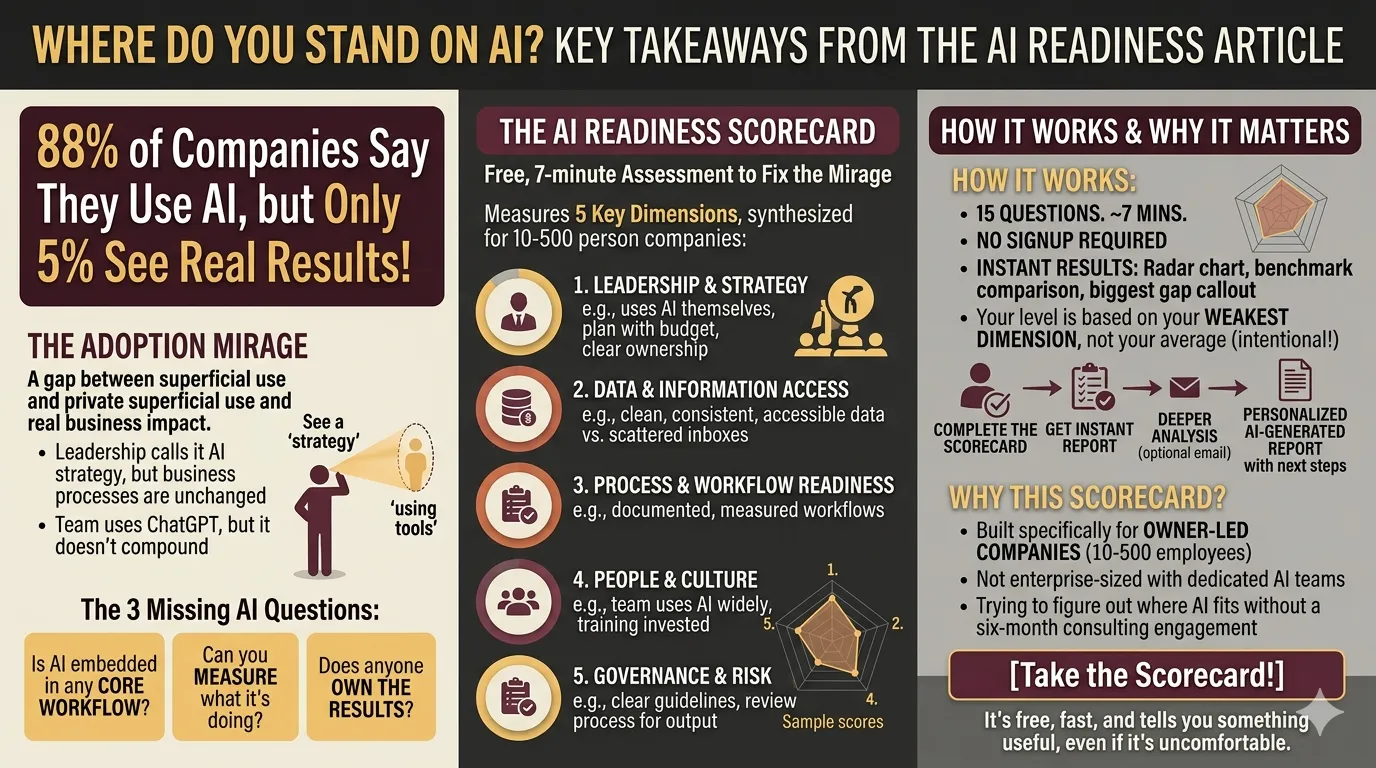
88% of companies say they use AI. Only 5% see real results from it.
That gap has a name; researchers call it the adoption mirage. A few people on the team use ChatGPT, leadership calls it “our AI strategy,” and everyone moves on. Meanwhile, the processes that actually run the business haven’t changed at all.
I’ve seen this pattern many times. A CEO/executive tells me they’re “already doing AI.” Then I ask three questions: Is AI embedded in any core workflow? Can you measure what it’s doing? Does anyone own the results? The answers are almost always no, no, and no.
That’s not adoption or a strategy. It feels productive. People are trying tools, getting faster at drafting emails, maybe summarizing documents. But none of it compounds. There’s no system behind it, no measurement, no connection to the work that actually drives revenue.
McKinsey found that the biggest barrier to AI value isn’t technology. It’s leadership. BCG found that 49% of companies are stuck at proof-of-concept and can’t get past it. The pilot graveyard is real, and it’s full of companies that thought they were further along than they were.
The first step to fixing this is knowing where you actually stand.
The AI Readiness Scorecard
I built the AI Readiness Scorecard to give business owners a clear, honest picture of how ready their company is to get real value from AI. Not how much AI you’re using, but whether you’re set up to make it count.
It measures five things:
-
Leadership & Strategy Does your leadership team use AI themselves? Is there a plan with budget and ownership, or just general enthusiasm?
-
Data & Information Access Is your key business data clean, consistent, and accessible? Or is it scattered across spreadsheets, inboxes, and people’s heads?
-
Process & Workflow Readiness Are your important workflows documented and measured? AI can’t automate what isn’t defined.
-
People & Culture How widely does your team use AI tools? Have you invested in training, or are a few enthusiasts carrying the load?
-
Governance & Risk Do you have guidelines for how employees should use AI? Is there a review process for customer-facing AI output?
These five dimensions come from synthesizing 20+ frameworks and stripping out everything that only applies to companies with 1,000+ employees. What’s left is what actually predicts whether a 10 to 500 person company will get value from AI.
How It Works
15 questions. About 7 minutes. No signup required.
You’ll get instant results with a radar chart showing your scores across all five dimensions, how you compare to benchmarks, and a clear callout of your biggest gap.
Your overall readiness level is based on your weakest dimension, not your average. That’s intentional. A company with great leadership but no data hygiene is not AI-ready. It has a great leader with a data problem. The scorecard tells you that directly.
If you want a deeper analysis, you can enter your email after seeing your results. We’ll send you a personalized report with specific next steps calibrated to your industry and company size.
Conclusion
Most AI readiness tools were built for enterprises. PwC, EY, Cisco, Microsoft — they all have frameworks, and they’re all designed for companies with dedicated AI teams and governance councils. If you have 50 employees and no data team, those frameworks aren’t just unhelpful. They’re misleading.
The scorecard is built for companies like the ones I work with. Owner-led, 10 to 500 people, trying to figure out where AI fits without a six-month consulting engagement.
Take the scorecard. It’s free, it’s fast, and it’ll tell you something useful. Even if that something is uncomfortable.